
Engineering
How this is actually built
These pages are written from the firmware and the source, not from a product brief. They describe what the hardware and the code do today, including the parts that are awkward - the inverted flame sensor, the sensor burn-in, the boot-time self-calibration, and the reasons the generative layer is kept on a short leash.
Alfa HazardX is a deployable V2 field node. No page here should be read as a certification claim.
The engineering pages
- The field nodethe field-node controller on a fabricated PCB: the full sensor set, the NORMAL/BURST state machine, the forensic black box and the closed-loop adaptive scanner.
- Hazard DNAA twelve-dimensional behaviour signature computed on the node. Judgement is about movement - velocity and acceleration - not raw values.
- The Adaptive Hazard ScannerSix acknowledged headings from one fixed installation point, and the electrically isolated second controller that turns them. How a scalar sensor is made directional.
- The Digital Hazard TwinA measured source projected onto the facility model, expanded at three horizons and intersected with a named asset register. Places, not parts per million.
- Hazard ReplayRecognition escalates the node from ten-second to one-second cadence, and every frame carries the system's own contemporaneous reasoning.
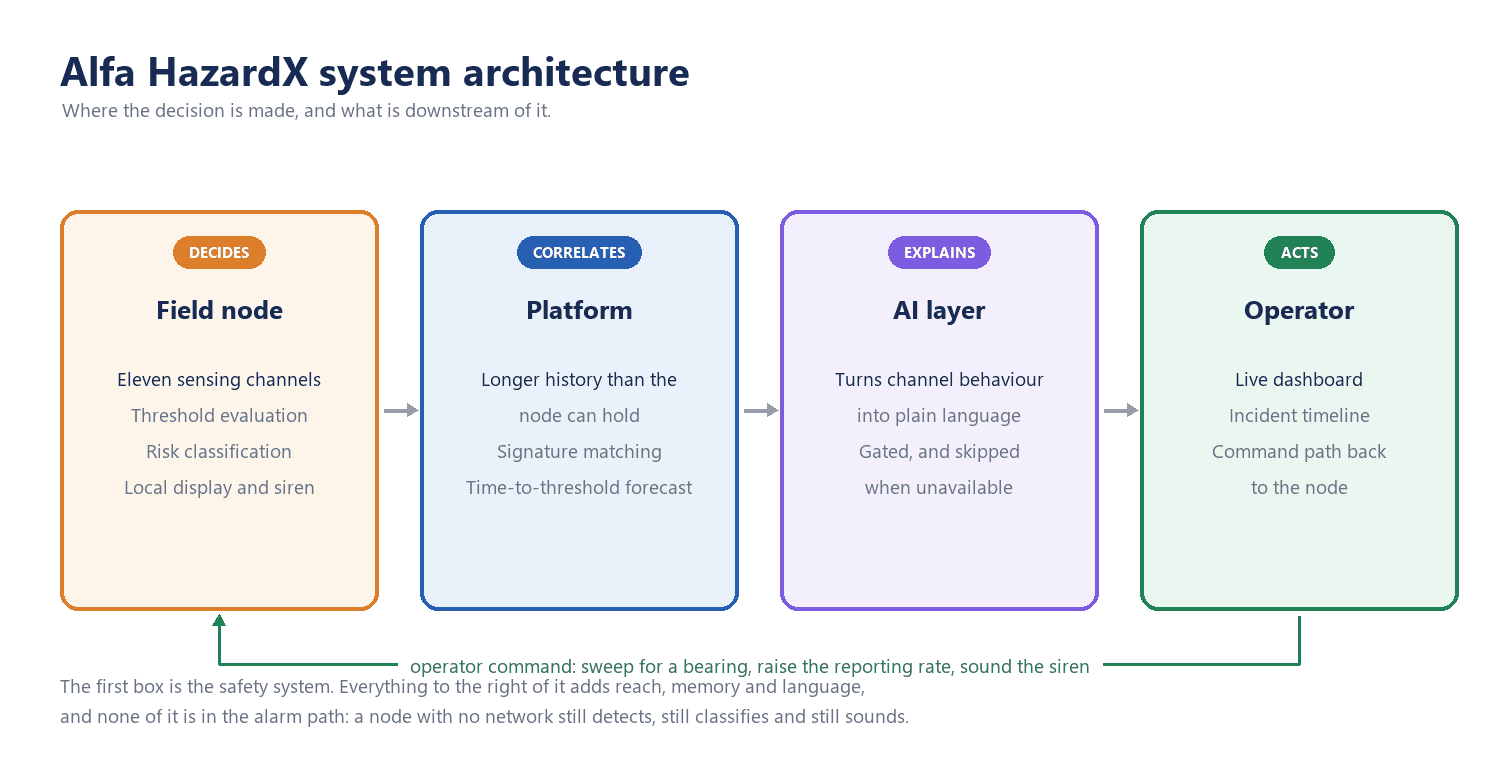
- System architectureThe eleven stages a reading passes through, from acquisition to the emergency command loop, with the architecture diagrams.
- The deterministic and advisory layersWhy the risk decision is arithmetic and the explanation is a language model, and why that split is not negotiable.
- Reference documentationWiring tables, config.h, the ingest API contract, threshold constants and the firmware variants.
- What is not built yetTraceable calibration, measured false-alarm rates, a production enclosure and a certification pathway.