The hazards in this environment
Every industry has a characteristic risk profile, and monitoring is only useful when it is aimed at that profile rather than at a generic list.
- Lint and cotton dust fire - Accumulated fibre is highly combustible and carries fire quickly across a space. Ignition sources include hot bearings, static and electrical faults in machinery that runs continuously.
- Machinery overheating - Spinning and weaving machinery runs constantly with many bearings. A hot bearing in a lint-rich environment is a direct ignition path, which makes mechanical condition a fire question here rather than just a maintenance one.
- Dye-house chemical vapour - Dyes, fixing agents, bleaches and finishing chemicals, often handled hot, in a humid space with variable ventilation.
- Boilers and steam - Wet processing needs steam. Boiler houses bring combustion products, carbon monoxide risk and pressurised systems.
What to monitor
Which channels matter, and in roughly this order of usefulness for this industry.
- Temperature, on machinery and ambient - the primary fire-precursor channel in dry processing
- Vibration and sound, for bearing condition on continuously running machines
- Smoke, with thresholds set for a naturally dusty environment
- VOC and air quality in dye houses and finishing
- Carbon monoxide in boiler houses
- Humidity, both as a reading and as context for interpreting the gas channels
Where the nodes go
Placement decides whether monitoring works. A node in the wrong place produces confident silence, which is worse than no node at all because it is trusted.
- Over carding and spinning machinery, where bearing heat and lint coincide
- In lint-accumulation areas and near extraction, which are the spaces a fire would travel through
- In dye houses at working height, accepting the humidity constraint
- In boiler houses, for CO and combustion monitoring
What prediction adds here
Dry processing is a strong case for bearing-condition prediction with a direct safety consequence: a bearing running progressively hotter in a lint-rich space is a fire in preparation, and heat, vibration and sound trending together give days of notice. In the dye house, the more useful predictive signal is a shift in the humidity-adjusted baseline, which flags a ventilation change before chemical concentration becomes a problem.
What Alfa HazardX covers today
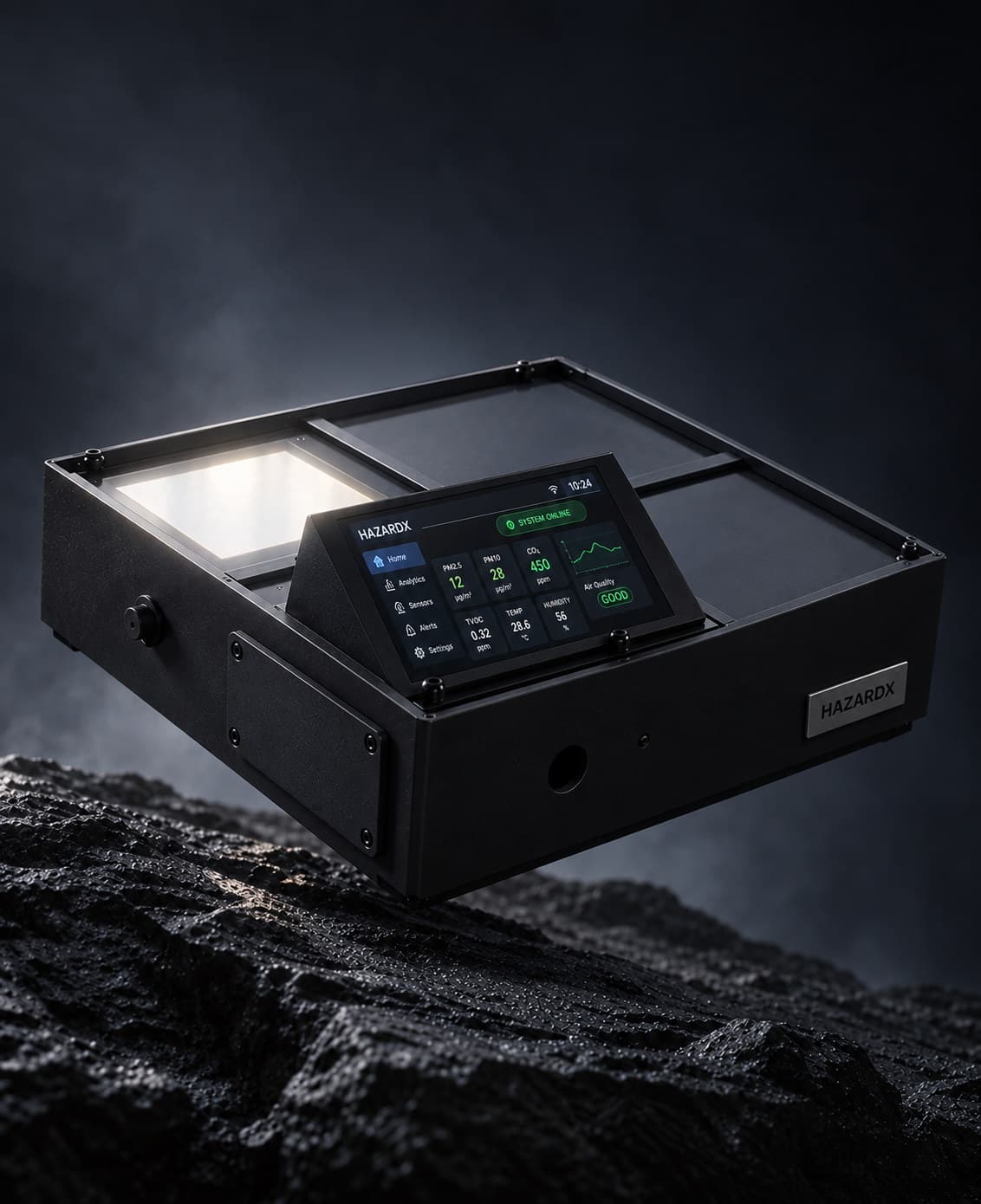
Temperature, vibration, sound, smoke, VOC, CO and humidity on one node, fused and trended. The dry-processing case is the stronger fit of the two.